Manchester United 3 Tottenham 0: United party like it’s 2008

The starting line ups

With 9 days to go before the end of the transfer window Spurs travelled to Old Trafford, which is already an unhappy hunting ground for them, with the uncertainty of star player Luka Modric’s future dangling over them. Manchester United had their own worries after being dealt a double blow in the game against West Brom as the injury bug bit both starting centrebacks Rio Ferdinand and Nemanja Vidic and questions were being asked about their young Spanish goal keeper David De Gea.

United’s dynamic attack

United started the better of the two teams putting Spurs under early pressure by moving the ball quickly and getting it into dangerous positions to create goal-scoring opportunities. They seemed determined to target Spurs young right-back Kyle Walker with majority of their attacks going down that flank in the first half. In the build up they would attempt to play an early ball to out to that flank in order for Ashley Young or Nani to try and get the better of the right-back in a 1v1 situation and whip in a cross. When the opportunity to capitalise from a quick build up wasn’t on the home team displayed the free flowing, interchanging of positions attack that Sir Alex Ferguson seems to have brought back from 2007/08. The wingers tucked in and played centrally or even doubled up on a single wing and the forwards took up deeper positions or played on the flank if it was left vacant by one of the wide men. One of the midfielders at times even joined in the rotation of positions. What this created was overloads either on the wings or in the midfield. Spurs played with 2 centre midfielders and United took advantage of this by making it a 3v2 situation in this area always. This overload would mostly consist of the one central midfielder who got forward, a striker who has dropped deep and winger tucked in. Quick passing in this area usually allowed them to find the spare man who then had the time and space to shoot from outside the area or raise his head to pick a pass with limited pressure on the ball. Observe Nani become the extra man in midfield and get a free uncontested shot off in the video below.

The 2 midfielders are preoccupied with Rooney (striker dropped deep), Cleverley (midfielder advancing forward) and Benoit Assou- Ekotto, who job it would have been to follow Nani inside, has his hands full with Welbeck who interchanged with the Portuguese winger. Also note that Cleverley ended up being one of the two furthest forward United players.

This free flowing attacking strategy worked well for the Red Devils (as it did in their previous 2 games) due to the universality of their attacking players. Rooney and Welbeck can both lead the line and play the support striker role or even on both flanks. Young and Nani also can play in either wide areas or behind the striker and can chip in with goals so won’t mind having to run on to a final ball. Both Cleverly and Anderson are very much comfortable having to play slightly higher up the park than their centre midfield positions with the former being no slouch on flanks. This versatility meant that each one of the attacking players could have found space in various parts of the attacking 1/3 and be comfortable to make a play when given the ball. Tottenham’s defense to an extent dealt well with United’s attack well with for the majority of the first half.  An audacious Young headed attempt and a Tom Cleverley shot from outside the 18 yard area.

Tottenham’s response

In the defensive phase Manchester United chose to press Spurs only when they crossed the half line in an attempt to force them to commit men forward and capitalise on the space left behind. Spurs used a slow, patient build up and waited for openings appeared to penetrate the home team’s defense. Their was some rotating of positions similar to United with Nico Krancjar advancing forward, Jermaine Defoe dropping to the midfield to receive possession and Rafael Van der Vaart floating all over the pitch to help with the build up, overload the wings and to get to the end of final balls. Bale also drifted inside from time to time to capitalise on space between the lines. However the reasons why United’s attacking play worked and theirs didn’t was their ball movement was too slow to give the defense any sort of problems, their fullbacks were more cautious (so they were undermanned in the attacking 1/3) and United’s attack had a much better understanding amongst themselves. Tottenham though did try to play some quick combinations and also tried to transition from defense to attack to catch their hosts on the counter attack. In terms of chances they were limited to shots from outside the 18 yard area and weak efforts that ended up straight to De Gea. United’s young centre-back pairing of Phil Jones and Jonny Evans did well to protect the young goalkeeper by cutting off attempts made to play in Jermaine Defoe. Jones, who made his first start for United also did an excellent job transitioning the defense to attack quickly with some wonderful runs (with the ball) out from the back after winning the ball back epitomising United’s tactics on the night, quick movement of the ball forward and overloads in attack.

The diagrams below shows United’s dominance in the 1st half.
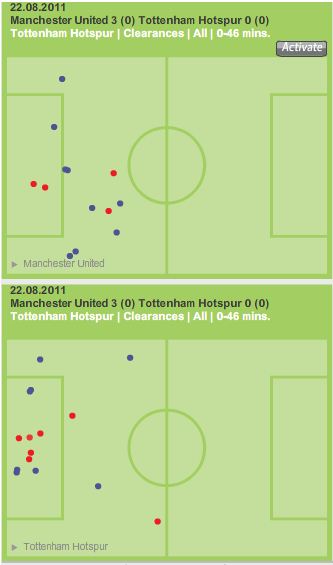
The above diagrams shows the comparison of where Manchester United (top) and Tottenham (bottom) attempted clearances. Spurs attempted 9 clearances inside their penalty area while United attempted only 4.
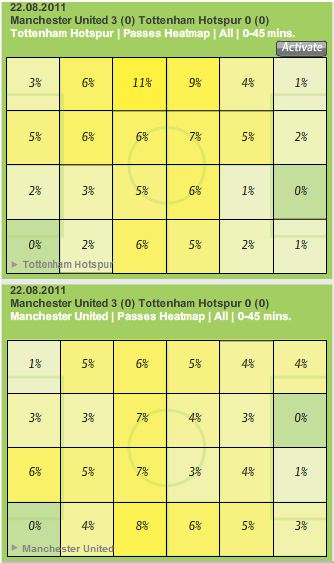
This diagram shows which areas of the pitch Tottenham (top) and Manchester United (bottom) made passes from. United had the comparative advantage in the attacking 1/3. 24% of their passes where played in this area in comparison to Spurs' 16%.

United turn on the style

In the early stages of the half Manchester United attempted to resume their dominance but it was Spurs who would threatened in the early minutes on on the counter attack. Soon after the match turned into an all United affair. The home team’s fluidity got progressively better as Spurs began to become more careless in possession and more gaps started to appear in their defense. United capitalised on this and really turned on the style.

In the video below Manchester United’s fluidity in attack can be seen (observe the various positions and roles picked up by different players) as well as their quick transitions from defense to attack to create goal scoring opportunities.

Harry Redknapp eventually switch to a 4-4-2 by bringing on Roman Pluychenko for midfielder Kyle Livermore and dropping Van Der Vaart to the midfield but this was to no avail as Spurs were out of it both mentally and physically and never really look up to mounting a proper comeback.

The synopsis of the second half was United started too get success (score goals) with the football they were playing as Tottenham drifted more and more out of the match

Conclusion

This was an exemplary performance by Manchester United as they continue to display the type of football that they want to play this season, which is a completely 180 degree opposite of the boxy and predictable attack from the last two years (which Ferguson implemented for the team to deal with the loss of Ronaldo and Tevez).

Tottenham, on the other hand, who just weren’t ready for this game (after their first game was cancelled and their squad clearly unsettled due to the transfer window) would not be too bothered about the loss and would hope that they have a clear view of the way forward for their team as the transfer window draws to an end by time they play Manchester City on Sunday.

Follow me on Twitter @jabari53
Soca Warriors’ opponents preview: India

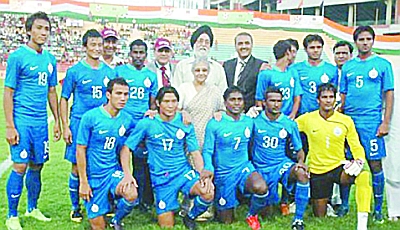
On Sunday August 21st Trinidad and Tobago’s national football team would play a friendly international versus India. This would be the Soca Warriors’ first match since being knocked out of the early stages of the Caribbean Cup almost 9 months ago. New head coach Otto Pfister’s would use this game as a warm up match for the upcoming CONCACAF Zone World Cup Qualifiers beginning on September 5th and an opportunity to see his locally based players in action (see Soca Warriors’ squad here). For the build up to the game, which would be analyzed by Firststopper.com, a colleague of mine Justin Jose, an Indian football fan and coach, has written a synopsis on the team from the sub-continent.

TEAM INDIA

“+ONE India Caribbean Tour 2011″ is a brilliant opportunity for the Indian national team to play against some higher ranked teams. This foreign exposure trip is all about providing the players with a new challenge and to prepare the team for the upcoming AFC Challenge Cup which is a pathway to the AFC Asian Cup for smaller Asian nations. After a small tussle between the AIFF and I-League clubs, players have been released for national team duty.  The Indian national team coach, Armando Colaco who has recently been given an extension on his contract will be hoping to continue his impressive progress with the national side.

SQUAD

Goalkeepers
Subrata Pal, Karanjit Singh, Laxmikant Kattimani

Defenders
Raju Eknath Gaikwad, Mahesh Gawli, Debabrata Roy, Gouramangi Moirangthem Singh, Rowilson Rolando Rodrigues, Robert Lalthlamuana, Sameer Subash Naik, Valeriano Joseph Rebello

Midfielders
Steven Benedic Dias, Mehtab Hossain, Climax Lawrence, Clifford Reyes Miranda, Syed Rahim Nabi, Peter Carvalho, Lalrindika Ralte, Rocus Lamare

Forwards
Sunil Chhetri, Jeje Lalpekhlua, C.S Sabeeth, Chongtham Sushil Kumar Singh

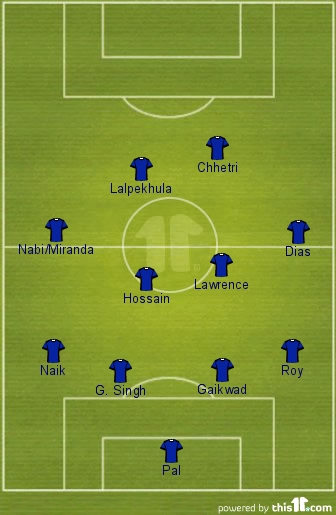
POTENTIAL STARTING LINEUP

Potential starting lineup?

PLAYING STYLE

Armando Colaco is a firm believer of possession football and is slowly implementing his style of play which bought him significant success with his old club Dempo SC onto the national team. It was refreshing to see India trying to keep the ball rather than the usual “hoof-it & run” style in the recent 2014 World Cup Qualifiers against UAE. Under Colaco’s regime the team has also been working a lot on set-pieces.

TACTICS

Colaco prefers to use an organized 4-4-2 formation with one of the strikers dropping deep to play between the opposition midfield and defensive lines.

STRENGTHS

  • Inspirational front two – Team India will trying to maintain possession and get the ball to forwards Sunil Chhetri and Jeje Lalpekhlua who they would towards to provide moments of magic.
  • Long throws – Raju Gaikwad’s long throws can trouble any defenses which fail to ideally prepare for them.
  • Spirit – Team India will definitely not lack fighting spirit and will definitely be up to give their all in this encounter.

WEAKNESSES

  • Defensive fragility – The defense often loses composure when put under pressure and is guilty of ball watching at times.
  • Giving up fouls in dangerous areas – Tough tackling Mehtab Hossain along with the members of the defense usually concede needless free-kicks in areas right outside the penalty box.
  • Goalkeeper – The over confidence and temperament of goalkeeper Subrata Pal can backfire at times.

KEY PLAYERS

Sunil Chhetri – The former Kansas City Wizards forward is definitely the star player to look out for. He is a clinical finisher, possesses excellent ball control and even though of a slight frame, he is strong in the air.

Jeje Lalpekhlua – The youngster from Mizoram is the best young talent in India. The diminutive Jeje has a lot of pace and can cause problems with his movement. His flicks and individual tricks are a joy to watch and can be a worry for opposition defenders.

Raju Gaikwad – The former Indian Arrows and India U-23 captain has made a seamless progress into the national senior side. The central defender is famous for his Rory Delap style long throws and India will make maximum use of his missile like throw-in’s. He is comfortable with the ball at his feet and ruthless in the tackle.

You can follow Justin on Twitter by clicking here or search for the Twitter handle @Justinho10

Arsenal vs Udinese: 1-0 to the Gunners

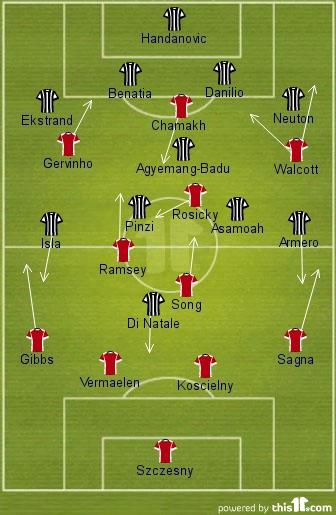
First half lineups

The post Cesc Fabregas era officially began on Tuesday night at the Emirates as Arsenal came up against the entertaining Italian unit, Udinese. Together with the Catalan-born midfielder’s departure questions also loom over the future of Samir Nasri and he was left out of the matchday squad with according to the club’s website a muscular problem. Jack Wilshere also did not feature as he was out with an injured ankle. For the Italians they were playing their first competitive match without Alexis Sanchez, Gokhan Inler and Christian Zapata all instrumental members of last season squad.

Before the game was settled into any particular pattern, Arsenal were already on top with a 4th minute tap in by Theo Walcott from a Aaron Ramsey right flank cross. The movement of the Arsenal players in the play leading up to the goal was a mere reflection of the fluidity that the Gunners would play with for the remainder of the half. Udinese seemed intent to sit back and play on the counter attack with the hope of nicking a goal through their talisman forward Antonio Di Natale.

Arsenal Rotating midfield

The Gunners midfield trio of Tomas Rosicky, Aaron Ramsey and Alex Song constantly rotated positions making it difficult to for the Udinese midfield to pick them up. In the build up their shape would usually be two of the midfielders holding and one advanced but as the move progressed into the attacking third this would switch to one holding, one advanced and the other in between the two.

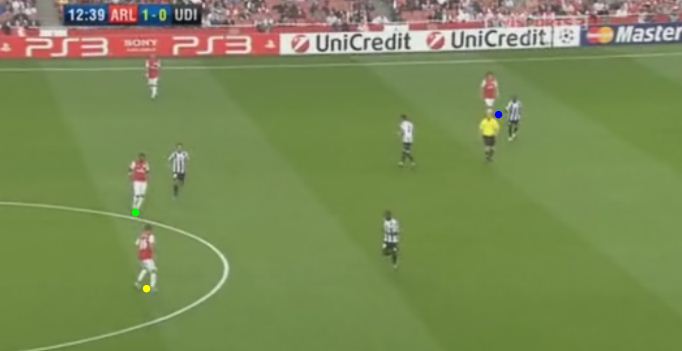
Song (green) and Ramsey (yellow) in holding postions as the play builds up with Rosicky (blue) in an advanced position

In the attacking third Rosicky (blue) advances with the ball and Ramsey (yellow) drops off while Song (not in picture) sits deeper

The advanced midfielder would usually make a forward run looking for the final ball capitalizing on the space created by Marouane Chamakh who played a false 9 role (This can be seen in the video below of Walcott’s goal). This rotating midfield trio helped to exploit a flaw in the Udinese system. The Serie A unit played with one holding midfielder, Agyemang-Badu, and due to the fact that the Gunners did not have a player playing consistently between the lines when he was drawn to the movement of one of their midfielders he often left a lot of space in front of the defense and this was exploited by either another midfielder making a forward run or a winger coming in off the flank.

Udinese’s dodgy defending

Intent to sit deep and play on the counter Udinese were surprisingly open. Besides the brilliant off the ball movement from Arsenal, Udinese was not compact in the defensive phase the space between there lines was too large most of the times and also their spacing amongst eachother left a lot to be desired. Debutant Neuton struggled in the left back position as he was given insufficient help from Pablo Armero who never looked comfortable in the defensive phase. Most of the Gunners success in the first half came down this flank. Overall as a defensive unit they were poor their marking wasn’t up to scratch, neither was their closing down of their opponents neither or tracking of runners. Arsenal main strategy to capitalise on Udinese’s poor defending was to play in runners in behind their defensive line by attempting defense splitting through balls and at times passes over the top.

In the above picture the large space between the Udinese defensive line and midfield can be seen (blue circle). Holding midfielder Agyemang-Badu (purple) is drawn to the ball leaving no one in between the lines to protect the back four.

Going forward Udinese looked threatening as they moved the ball quickly out of their half  trying to catch Arsenal out.  Most of their attack consisted of trying to play in Antonio Di Natale who was giving Arsenal’s defenders a lot to think about with his movement. Such was his threat that he caused Arsenal to play a bit deeper usual. When Udinese won the ball off Arsenal they were also able to play in either Pablo Armero or Mauricio Isla who capitalised on the space left behind by Keiran Gibbs and Bacary Sagna who were going forward aggressively in the Gunners’ attempt to pin their opposition back. Most of their attacks were with the three aforementioned attacking players with Giampero Pinzi and/or Kwadwo Asamoah supporting at times.

Guidolin makes a much needed adjustment

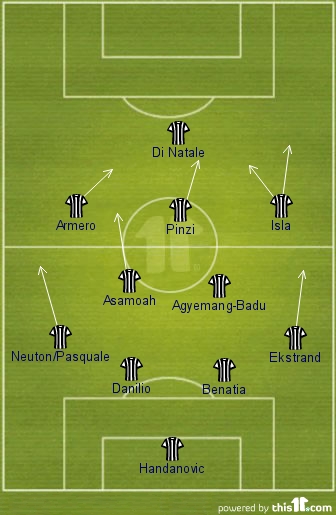
As the first half drew to its final stages the Udinese coach, Francesco Guidolin, switch his 4-1-4-1 defensive shape to a more compact 4-2-3-1 dropping Asamoah to play alongside Agyemang-Badu in front of the defense. Pinzi remained as the lone advanced midfielder. This change allowed either of the two holding midfielders to closely mark one of the ‘rotating midfield trio’ which may come into that zone and not have to worry about leaving space in behind as the other would cover for him. This proved to be a masterstroke as the Italians were now less porous and this gave them a proper foundation to build upon as they attempted to get back into the match.

La Zebrette takes charge

Udinese's lineup for the second half.

After the break Udinese came out looking for the equaliser and began to press Arsenal higher up the pith and made it difficult for them pass the ball comfortably out of their half as they did in the 1st half. The momentum was now with the visitors as they spent most of the half in their host’s half. Their fullbacks picked up positions higher up the park, Asamoah left his deep position to support the attack (in the defensive phase he remained alongside Agyemang-Badu) and Armero, Pinzi and Isla all tried to link up with Di Natale in an attempt to break the Gunners’ defense down. They did play some impressive football. Armero, in particular, had a much better half partially because Udinese had the upper hand and he had less defending to do than in the 1st half.

Arsene Wenger’s men were forced into playing a lot of long balls out of the back by their and never seem to get a grip of their high pressing. They did though have opportunities to extend the lead as they utilised the pace they have on top to capitalise on large spaces being left by an Udinese team who were growing in confidence. The French tactician did make a tactical substitution during the course of the half and this was to take off Rosicky and bring on Emmanuel Frimpong. This substitution was obviously to add more steel to the midfield. Frimpong though did not come on to play a holding role together with Song in order for Arsenal to see out the tie with a 1 goal advantage but instead he joined in the ‘rotating midfield trio’ as they tried to win back the midfield with some physicality.

Conclusion

In the end Udinese were clearly the better team throughout the 2nd half but didn’t have a goal to show for it and would think they have seen enough of Arsenal to have a go at them in the return leg. The Gunners on the other hand would be disappointed that they didn’t score a next goal in order to take a comfortable 2-0 lead to the Stadio Fruili in a week’s time.

Tactically, the visitors were outwitted early on by the home team’s movement and intelligent overloads especially in between the lines but once Guidolin had adjusted his formation and get his team to be more compact Udinese was right back into the tie. It should be interested to see what sort of tactics would be implemented by both coaches but more so by Arsene Wenger giving that his side was clearly outplayed in the latter half of this leg.

Liverpool vs Sunderland: Kenny’s men fail to dominate

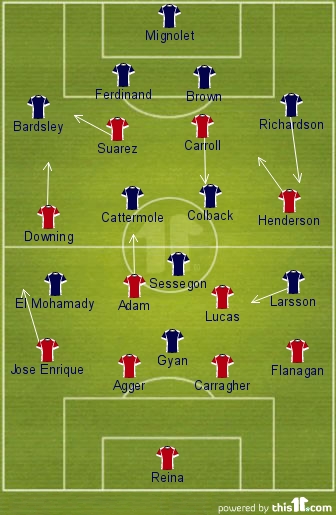
The starting lineups

The Kenny Daglish-era at Liverpool continued into the 2011/12 season with a plethora of new signings, new found hope of Champions League qualification and what seems to be a brighter future for the Anfield unit in comparison to 12 months ago. Their first fixture of the new season was a visit from Steve Bruce’s Sunderland who similarly has heightened expectations and seem to be aiming for a top 7 finish given the signings they made over the summer.

To the surprise of many, Raul Miereles and Dirk Kuyt were left out of the starting line up for Liverpool with debutants Stewart Downing and Jordan Henderson starting instead.Charlie Adam also made his debut. Luis Suarez who had only returned to training 1 week prior week from his summer holidays which followed his successful Copa America campaign with Uruguay was another surprise starter. For Sunderland debuts were handed to new signings Wes Brown and Sebastien Larsson.

From the kickoff it was clear what the attacking strategies of both teams would be. Sunderland attempted to play the ball into Asomoah Gyan as quickly as possible for him to knock down or pass to support striker Stephen Sessegnon who would then tr to link up with link up with the Ghanaian with a quick 1-2 or get the ball to the flanks so that they could have gotten crosses in. Liverpool, surprisingly, were also a bit direct in their play but they were more purposeful in possession by keeping the ball (a bit) longer and linking up play better.

Liverpool attacking strategy

The Merseyside team started off the game by playing the ball down the channels for their forwards to run onto. Suarez and Carroll drifted out to the wide areas to combine with the wingers and full backs in an attempt to overload the wings or create openings for teammates. They also played the long ball out of the back with Andy Carroll being the main recipient whose job it was to knock the ball down to his strike partner or midfielders. Liverpool also attempted to get in behind the Sunderland backline by way of quick combination play and also counter attacks on the few occasions the opposition got forward in numbers.  Their passing was crisp, precise and full of intent in the first half and though they weren’t as fluid as they were at the back end of last season they were looking good enough for the first game of the season.

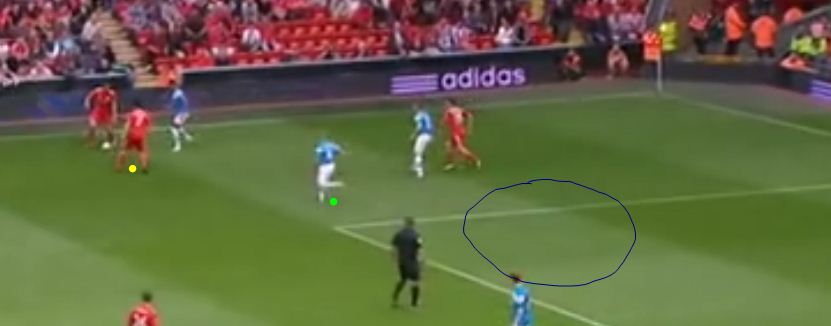
Suarez (yellow) drifting out to the wing taking his marker (green) with him and creating space (blue circle) for teammates to run into. If he is left alone this creates a 3v2 overload on the wing.

Synopsis of Sunderland’s first half 

In the defensive phase Sunderland sat back and tried to absorb Liverpool’s attack. They defended in a 4-4-1-1 shape with Sessegnon sometimes pushing up to assist Gyan in pressing the centrebacks. Liverpool’s central midfield pairing of Lucas Leiva and Charlie Adam were allowed time on the ball as the Sunderland midfielders sat right in front of the back four. Steve Bruce’s attacking strategy went well for all of 4 minutes as Liverpool weren’t settled into their rhythm as yet and Sunderland attack was able to combine and win 2 corners in the space of 3 minutes. After this period their target man Asamoah Gyan was being crowded out by Jamie Carragher and co. and did not win a single aerial duo for the remainder of the 1st half neither was he allowed to get to passes played into him. Due to Sunderland’s non-committal of men in attack, lack of patience when in possession and the Ghanaian being upfront on his own Carragher and either Agger or a fullback were able to double up on him and make his task difficult. Liverpool’s defense thus made Sunderland’s main attacking outlet redundant and this enabled them to dominate proceedings for the remainder of the half.

Observe the large amount space between Charlie Adam (yellow) and Sunderland midfielders (green). This illustrates how deep Sunderland was defending

When Luis Suarez made amends for a missed penalty and put Liverpool in front they seemed to be on their way to an opening day victory but poor game management ensured that this did not happen. The thing about teams who play a direct style is that it is much harder to control a game when playing this way as the length of time one stays in possession is not that long to frustrate an opponent. Also Liverpool did not get the second goal which would have definitely killed off this game off so Sunderland was able to still play with some caution knowing that they only needed one goal to get back in the tie. At the end of the half  they did play higher up the park but rarely threatened Liverpool but they were allowed enough of the ball to feel like they were still in for a point at least.

2nd Half

Sunderland came out of the break with a lot more purpose and intent, they pressed higher up the field and the momentum of the game was now shifting. Liverpool started to become very careless in possession as they lacked the precision which they had in the 1st half. They even tried to capitalise on spaces left behind by a more advanced Sunderland but to no avail as inaccurate passes saw them struggle to get out of their half at times at the beginning of the 2nd period. During this period of dominance Sunderland equalised through a stunning volley by Sebastien Larsson. Liverpool were now jaded and Sunderland were the team playing with all the confidence.

King Kenny reacts

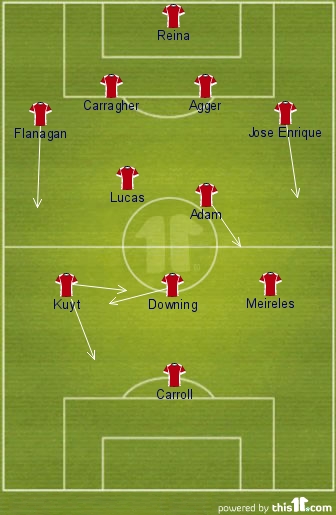
The Liverpool legend soon after made a change to his starting line up by bringing on Dirk Kuyt for Henderson who instantaneously linked up well with Suarez on the right flank and created a chance which was blocked and went out for a corner. In Liverpool’s case its a pity he didn’t start  because he and Suarez has great chemistry as was shown last season and he would have help their attack be a bit more fluid. Their time on the pitch together lasted a mere 15 minutes and didn’t bear much fruit as the Uruguayan was clearly not in top shape and looked exhausted for most of the 2nd half. His replacement was Raul Meireles, who has been probably Liverpool’s best player under Daglish, and the team was now lined up in 4-2-3-1 shape with Meireles, Downing, Kuyt play in the ‘3’ with the latter two interchanging the wide right and central roles with Kuyt sometimes supporting Carroll up top.

Liverpool's shape when looking for the winner late on.

Not much came out of Liverpool with their new shape as they still could not create any threatening chances and break down Sunderland’s resolute defense.

Conclusion

Liverpool, though they showed positive glimpses early on they were not convincing enough throughout and would need to play a style of football similar to that which they played at the back end of last season if they would like to achieve Champions League qualification. At the post match news conference Kenny Daglish did say that the team needed time to gel but one would hope that the fluid Liverpool of a few months ago has not been converted into a defensive unit who are just interested in grinding out results.

Sunderland were unsurprisingly cautious as they played away from home. They did well defensively and progressively got back into the game and got a well deserved draw.

Overall nothing really happened in the game tactically and a draw was a suitable result as both teams had their moment. This match was definitely not a clear indication of how both teams would play throughout the season as both teams have a lot of new players on their rosters and it will take time before they both get their identities.